
Stop Giving Discounts Without Showing Them
Discounts aren’t the problem.
Invisible discounts are.
Whether you should give a discount at all is a separate discussion. In this article, we’re focused on something far more practical: how to use discounts in your favor instead of quietly eroding your margins.
Most companies discount the easy way. They simply adjust the retail price on a product or reduce the labor rate and move on. The invoice goes out, the client is happy, and the job gets closed.
So why change what works?
Because while it works in the moment, it fails you long-term in two critical ways.
The Two Hidden Problems With “Quiet” Discounts
- Your Client Never Sees the Gesture
When you quietly reduce the price, the client has no idea you did them a favor.
There’s no line item.
No callout.
No reminder.
Unless you verbally point it out every time, the goodwill disappears the moment the invoice is paid. Over time, that discounted price becomes the expected price.
You didn’t build loyalty.
You trained pricing expectations.
- Your Financials Lose the Story
From an accounting perspective, silently lowering prices is even more damaging.
When you adjust retail pricing:
- Gross profit drops
- Revenue appears lower
- There is no visible explanation for why
Later, when you’re reviewing financials, margins look weak and there’s no clean way to answer a simple question:
“Why is our GP lower than it should be?”
The data doesn’t tell the story because the discount never existed on paper.
The Fix: Show the Discount, Don’t Hide It
The solution is straightforward and proven:
use discount products instead of adjusting retail pricing.
This applies to both products and labor.
By introducing discount line items, you accomplish two things at once:
- Your client sees the discount clearly
- Your financials retain the full picture
You’re no longer giving money away quietly.
You’re making a deliberate, documented business decision.
Two Proven Ways to Structure Discount Products
There isn’t a single “right” way to do this. There is a right way for your reporting style. Below are two common, effective approaches.
Option 1: One-to-One Discount Mapping
In this model:
- Each discounted item has a matching discount product
- Classifications mirror the original product or labor type
- The discount posts as negative revenue to the same account
What this gives you:
- Accurate revenue by category
- Clean gross profit tracking
- Visibility into how much you discounted per service type with more detailed reporting.
This approach is ideal if you care deeply about granular reporting and want discounts tied directly to the revenue they reduce.
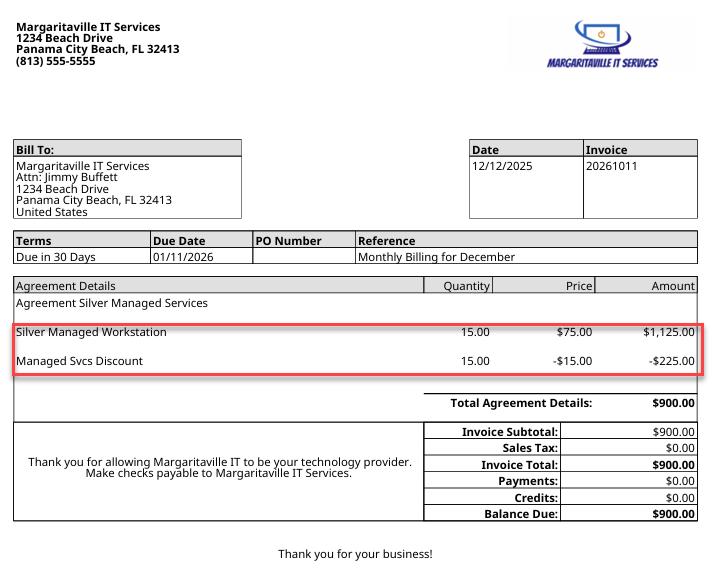
Invoice view showing original line item followed by matching discount line item.
Option 2: One-to-Many Discount Mapping
Here, you use:
- A single discount product (or a small set)
- Mapped to a dedicated “Discounts Given” revenue account
What this gives you:
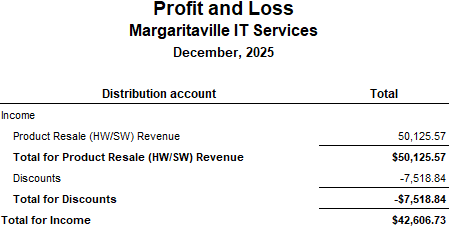
- A clear, visible line item on the P&L
- Immediate insight into total discounts given
- No additional reporting effort required
When you open your P&L, discounts stand on their own. No hunting. No guessing.
This approach works well for leadership teams who want clarity without complexity.
Why This Matters More Than Ever
In tighter markets, margins matter.
In competitive markets, perception matters.
In mature businesses, clarity always matters.
Discounting doesn’t have to weaken your position. When done correctly, it becomes:
- A visible value add for clients
- A controlled lever for sales
- A measurable decision for finance
The businesses that last aren’t afraid to discount.
They’re afraid to discount blindly.
Final Thought
If you’re going to give a discount, own it.
Show it.
Track it.
Learn from it.
That’s how you protect your margins, reinforce your value, and keep your financials telling the truth.
If your system isn’t set up to do this cleanly today, that’s not a failure. It’s an opportunity to tighten the foundation and move forward with confidence.