
The Cost of Convenience: When “Just This Once” Becomes Your Process
Every successful business runs on processes.
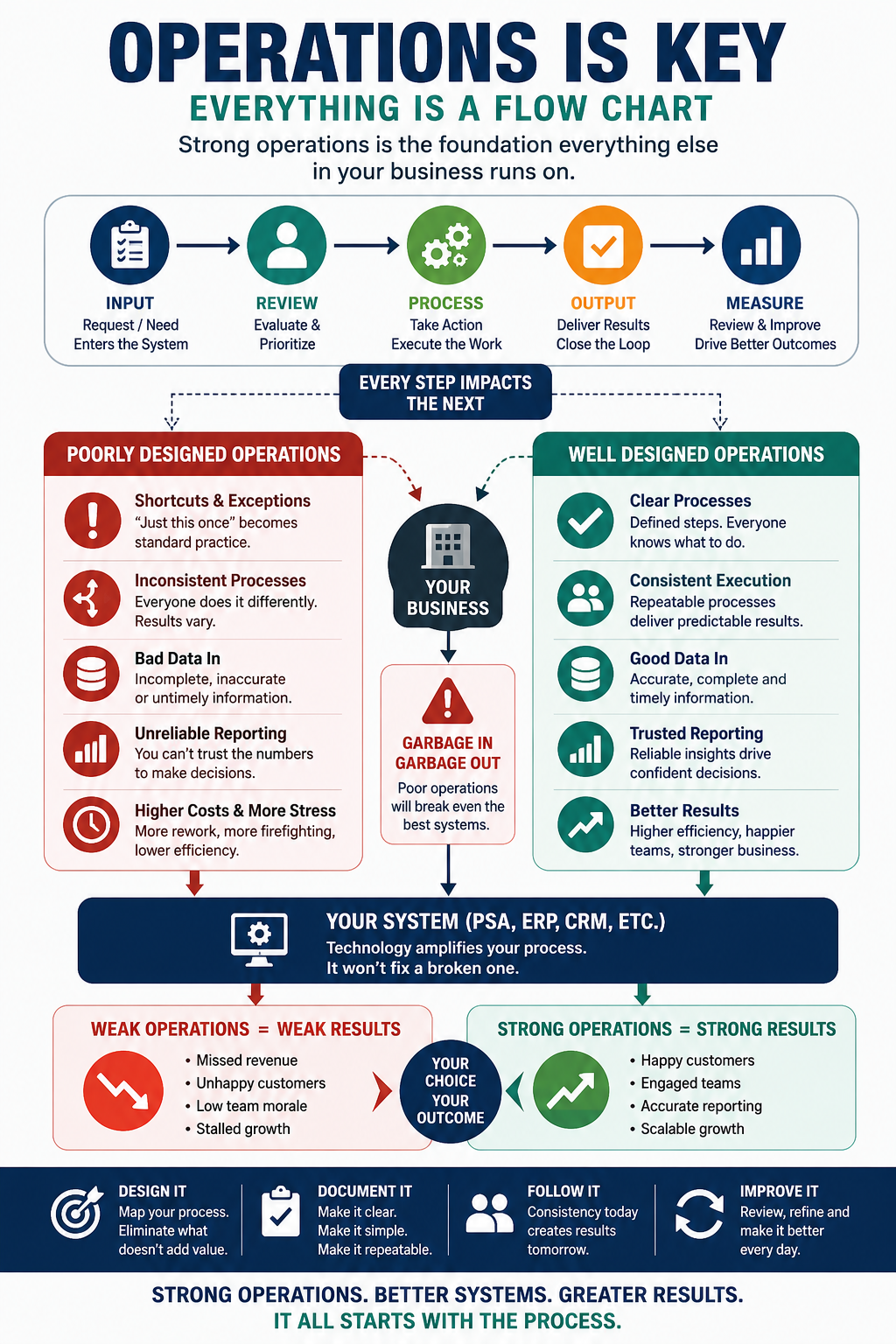
Whether documented or not, every task, decision, handoff, approval, and customer interaction follows a path. Think of it as a flowchart. Something happens, someone takes action, a decision is made, and the process moves to the next step.
The problem is that many businesses don’t intentionally design those flowcharts.
Instead, they evolve over time through shortcuts, exceptions, and workarounds.
And that’s where the trouble begins.
Operations First. Technology Second.
Many organizations believe a new PSA, ERP, CRM, or business platform will solve their operational problems.
Unfortunately, technology rarely fixes broken operations.
In reality, software amplifies existing processes. Good processes become more efficient. Bad processes become faster at producing bad results.
A poorly designed operational process is like building a house on a weak foundation. It doesn’t matter how impressive the structure above it appears. Eventually, the cracks begin to show.
We’ve seen organizations spend significant time and money implementing systems only to discover that the underlying process was never clearly defined.
The software wasn’t the problem.
The operation was.
How “Just This Once” Becomes Standard Practice
Most process problems don’t start with bad intentions.
They start with convenience.
A technician bypasses a step because they’re busy.
A manager approves an exception because a client is upset.
Someone manually adjusts an invoice because it’s faster than fixing the root cause.
Someone creates a new status, queue, category, or process because the existing one doesn’t quite fit.
At the time, each decision seems reasonable.
The problem occurs when nobody goes back to fix the original issue.
One exception becomes two.
Two becomes ten.
Eventually, nobody remembers what the actual process was supposed to be.
The Hidden Cost of Process Debt
Technical debt gets plenty of attention in our industry.
Process debt deserves the same respect.
Process debt occurs when temporary solutions become permanent procedures.
Common symptoms include:
• “We’ve always done it that way.”
• “Only one person knows how this works.”
• “The report isn’t accurate.”
• “Just ignore that status.”
• “That workflow doesn’t really do anything anymore.”
These aren’t software problems.
They’re operational problems.
And over time they become expensive.
Reduced Efficiency
Employees spend time navigating around exceptions instead of following a clear process.
Inconsistent Results
Two team members perform the same task differently because the process isn’t clearly defined.
Poor Reporting
When data is entered inconsistently, management loses confidence in the numbers.
Difficult Training
New employees struggle because they’re being taught exceptions rather than standardized procedures.
Every Process Should Have a Purpose
Before creating a new step, ask yourself:
• Why does this exist?
• What problem does it solve?
• Is it repeatable?
• Is it documented?
• Would a new employee understand it?
If the answer isn’t clear, the process may need refinement.
Good operations aren’t built around people.
They’re built around repeatable outcomes.
Technology Should Support the Process
Once an operational process is clearly defined, technology becomes incredibly powerful.
A PSA can automate tasks.
A CRM can streamline communication.
An ERP can improve financial visibility.
But all of these systems depend on one thing:
A well-designed process underneath them.
The software should support the operation, not define it.
A Real-World Example
Many organizations eventually find themselves manually correcting invoices every month.
The immediate reaction is often to blame the software, the accounting package, or the invoicing process.
In reality, invoice corrections are often a symptom of a larger operational issue.
Perhaps agreement billing was never designed properly.
Maybe products are being added inconsistently.
Maybe employees were taught a workaround years ago that became standard practice.
The invoice isn’t the problem.
It’s simply where the operational problem finally becomes visible.
This same pattern can be found throughout the business. Service delivery, sales, procurement, project management, accounting, and reporting all follow the same principle.
The output is only as good as the process that created it.
Wrap-Up
Every business follows a series of flowcharts, whether intentional or accidental.
The most successful organizations regularly review those flowcharts, eliminate unnecessary exceptions, and focus on creating repeatable processes that deliver consistent results.
Because at the end of the day, technology doesn’t create operational excellence.
It simply magnifies it.
If your operations are strong, your systems will thrive.
If your operations are weak, no software implementation will fix the problem.
Start with the process.
Everything else gets easier from there.