

Solving Non-Tech Problems
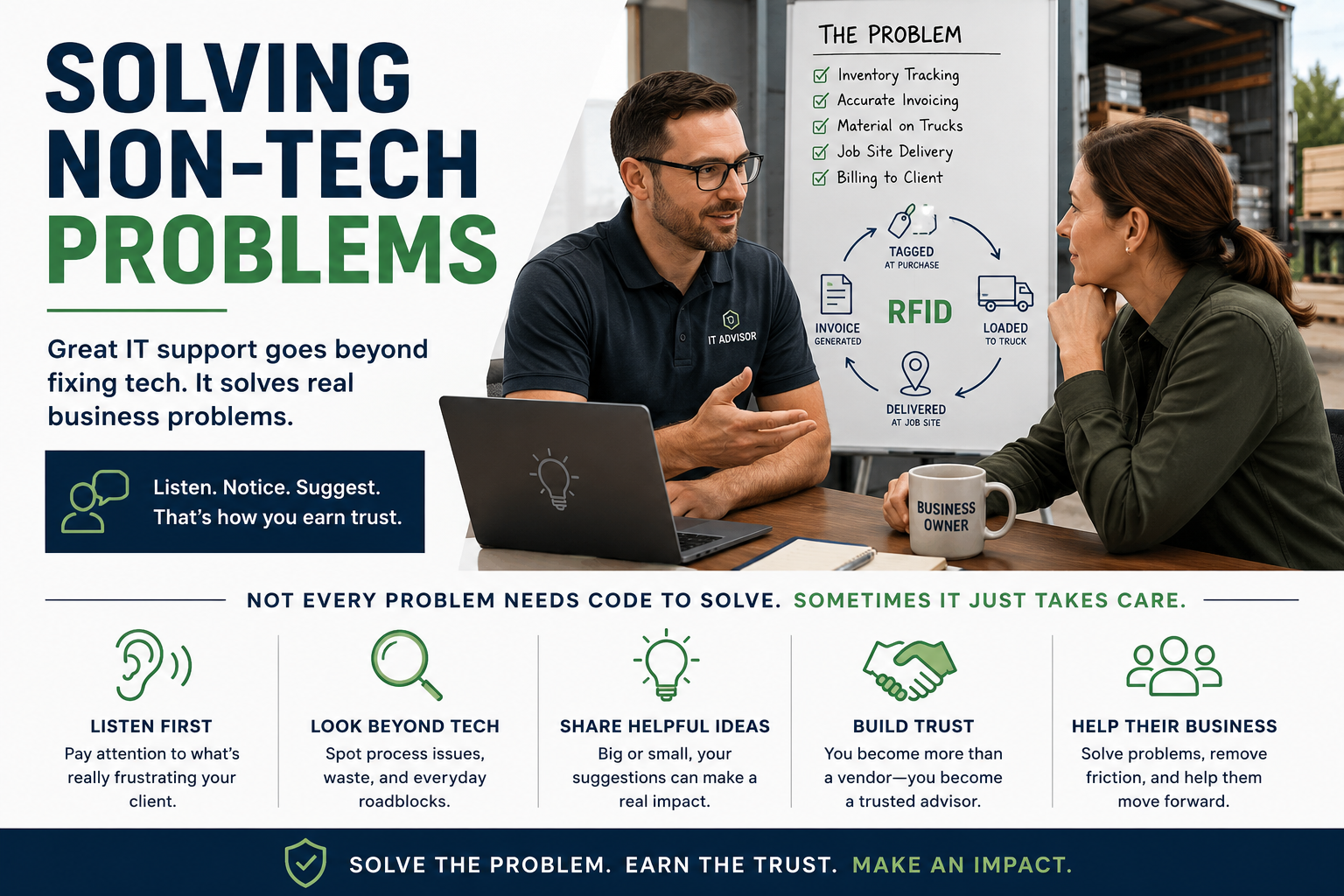
Your client may have hired you for technology, but they will trust you because you paid attention.
Too many IT providers walk into a client’s business with blinders on.
They look at the server.
They check the firewall.
They update the software.
They solve the ticket.
Those things matter. But they are not the whole picture.
Behind every help desk request is a business full of people, processes, frustrations, habits, and small problems that quietly cost time and money. Some of those problems are tied directly to technology. Some are not. But all of them affect the client’s day.
And when you are the person who notices, listens, and offers a useful idea, you become more than “the IT person.”
You become trusted.
The Client’s Problem Is Not Always Technical
Walk into almost any business and you will find something that needs fixed.
Maybe invoices are not matching inventory.
Maybe employees are wasting time on a clumsy process.
Maybe the front desk has poor lighting.
Maybe ants keep showing up near the breakroom.
Not every problem requires a login, a password reset, or a new piece of software.
But every problem is an opportunity to serve.
This is where many technical professionals miss the bigger opportunity. They are trained to look for technical failures, so they sometimes overlook human frustrations happening right in front of them.
The better approach is simple:
Pay attention to the business, not just the technology.
A Fence Company, an Inventory Problem, and a Better Idea
A fence company was struggling with inventory and proper invoicing.
Materials were being purchased, moved, loaded onto trucks, delivered to job sites, and eventually billed to customers. But somewhere along the way, the process was breaking down. Items were hard to track. Billing was not always accurate. The owner was frustrated.
During a conversation, the IT technician listened closely.
The issue was not presented as an IT project. It was just a business owner talking through a headache.
But the technician recognized the pattern. He had recently learned about RFID technology and saw how it could help.
Fence posts and similar materials could be tagged when purchased. When they were loaded onto a truck, the system could record the movement. When they were removed at the job site, the system could mark them as delivered and ready to bill.
What started as a non-technical conversation became a technology project.
But that only happened because someone listened before trying to solve.
Useful Suggestions Build Trust
The point is not that every client problem should turn into a major IT project.
Sometimes the best suggestion is small.
A client may mention an ant problem, and you may know a simple way to get rid of them. That has nothing to do with computers, but it helps.
You may find a monitor-mounted LED light that makes a desk easier to work at. It is only loosely connected to technology, but it improves someone’s day.
You may notice that a team keeps printing the same form over and over, walking it across the office, and manually filing it. That may lead to a workflow fix.
The size of the idea is not the point.
The point is that you cared enough to notice.
The More Human You Are, the More Trusted You Become
Clients do not only evaluate you by your technical skill.
They evaluate you by how safe they feel when you are involved.
Do you listen?
Do you understand their business?
Do you explain things clearly?
Do you notice what is slowing them down?
Do you offer ideas without making them feel foolish?
Trust grows when a client realizes you are not just there to close tickets. You are there to help the business work better.
That kind of relationship is hard to replace.
Look Beyond the Ticket
The next time you are onsite with a client, slow down and look around.
Ask what has been frustrating lately.
Listen for repeated manual tasks.
Pay attention to complaints that sound small.
Notice where people are wasting steps, time, or energy.
Offer helpful ideas, even when they are not strictly “IT.”
This does not mean you become a pest control expert, lighting consultant, or operations manager.
It means you become a better guide.
Your client is trying to run a stronger business. Your role is to help them remove obstacles when you can, point them in the right direction when you cannot, and bring thoughtful ideas to the table.
Final Thought
Technology is often the doorway into a client’s business.
But trust is built by what you do once you are inside.
Solve the technical problems, of course. That is the job.
But do not stop there.
Listen to the business owner. Watch how the team works. Notice the small frustrations. Share the helpful idea.
Because sometimes the problem that earns the most trust is not the one on the ticket.
It is the one nobody expected you to care about.