

Stop Playing Hero Ball: Why MSP Operations Need a Team, Not a Roadblock
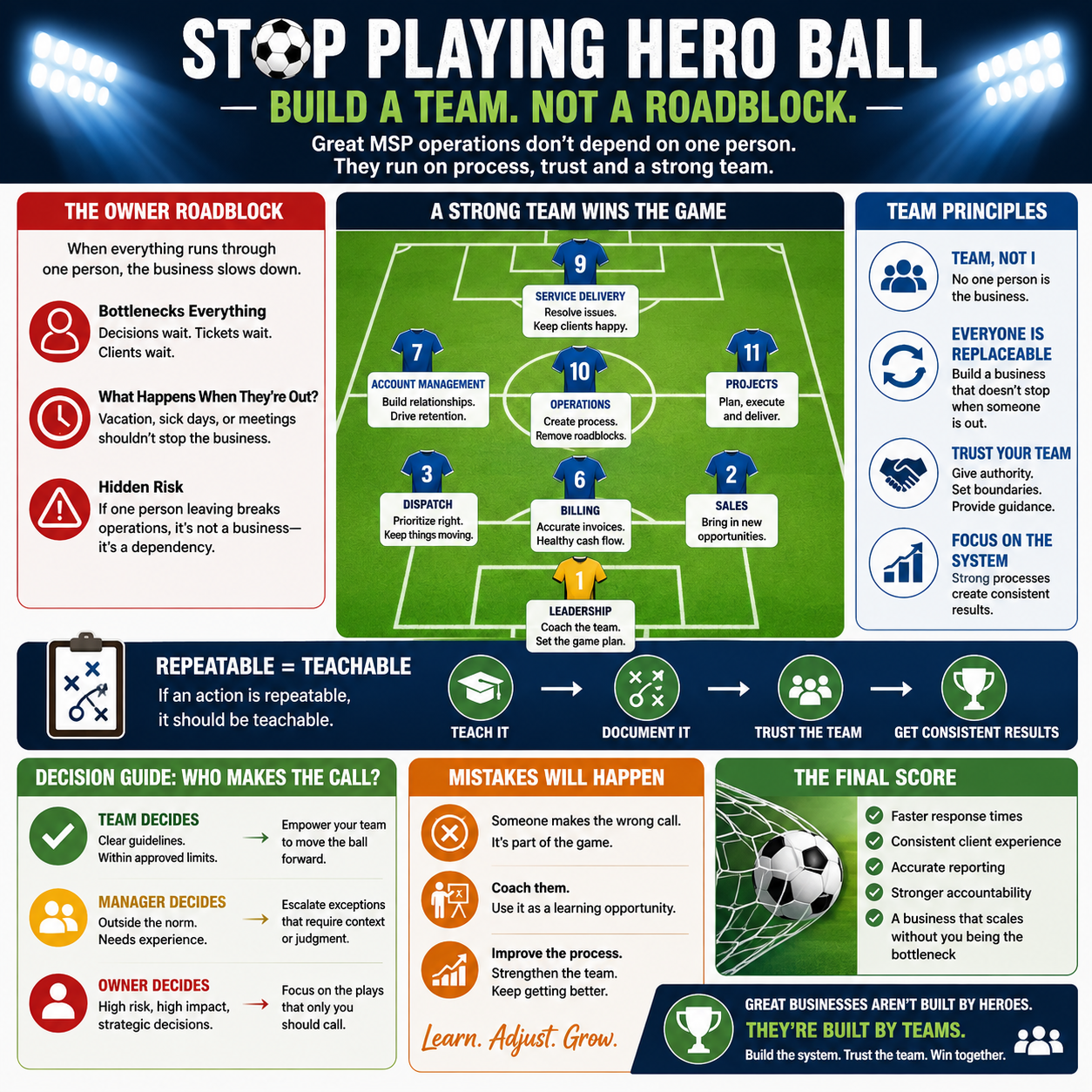
In soccer, one player cannot win the match alone.
Sure, you may have a star striker, a great keeper, or a midfielder who seems to be everywhere at once. But if the entire team has to wait for one person before making a move, the game falls apart.
The same thing happens inside MSP and TSP operations.
When every decision, approval, exception, client issue, pricing question, or process change has to run through one person, the business slows down. It may feel controlled. It may feel safe. It may even feel responsible.
But in reality, it creates a bottleneck.
And more often than not, that bottleneck is the owner.
The Owner as the Roadblock
Owners are usually the worst offenders.
That is not meant as an insult. It makes sense.
The owner built the business. They know the clients. They know the history. They know why certain decisions were made. They know which clients are easy, which ones are difficult, and which ones need a little extra attention.
The problem is when that knowledge never gets transferred to the team.
Instead of building a process, the business builds a dependency.
Instead of empowering employees, everything gets routed back to the owner.
Now the owner is not leading the business.
They are standing in the middle of the field asking everyone to pass them the ball.
Team, Not I
A strong MSP does not run on one person.
It runs on a team.
Service delivery, billing, dispatch, projects, sales, account management, procurement, and operations all need defined roles. Everyone should know where they fit, what decisions they can make, and when something should be escalated.
That does not mean every employee gets unlimited authority.
It means repeatable decisions should not require executive approval every single time.
If something happens daily, weekly, or monthly, it should have a process.
If it has a process, it should be teachable.
If it is teachable, it should not live only inside the owner’s head.
Repeatable Means Teachable
This is one of the simplest operational tests:
If an action is repeatable, it should be teachable.
A one-off issue? Sure, run it through a manager or owner.
A unique client situation? Escalate it.
A major financial decision? Get leadership involved.
But if the same question comes up over and over again, the answer should not depend on who is available that day.
Document it.
Train it.
Build a decision tree.
Create approval thresholds.
Define what the team can handle and what needs escalation.
The goal is not to remove leadership from the process.
The goal is to stop using leadership as the process.
What Happens When the Manager Is Out?
We see this often.
A manager wants all certain items routed through them so they can make the final call. The intention is usually good. They want accountability. They want consistency. They want to protect the team.
But what happens when that manager is out?
What happens when they are on vacation?
What happens when they are sick?
What happens when they are stuck in meetings all day?
The team waits.
Clients wait.
Tickets wait.
Billing waits.
Projects wait.
That is not control.
That is dependency.
If the process only works when one specific person is available, it is not a process. It is a risk.
Trust Is Not Optional
One of the biggest mistakes owners and managers make is not trusting their team.
Yes, employees will make wrong choices.
That is part of business.
The answer is not to take every decision away from them. The answer is to use those mistakes as training opportunities.
When someone makes the wrong call, ask:
• Was the process clear?
• Was the employee trained?
• Did they understand the expected outcome?
• Was there a decision tree to follow?
• Did leadership create confusion by making exceptions in the past?
Sometimes the employee made a bad decision.
Sometimes the business failed to give them the tools to make a good one.
There is a difference.
Everyone Is Replaceable, Including the Owner
This one stings a little.
Everyone is replaceable.
Technicians are replaceable.
Dispatchers are replaceable.
Managers are replaceable.
Owners are replaceable too.
That does not mean people are not valuable. It means the business should not collapse when one person is unavailable.
If one person leaving, taking vacation, or being sick breaks the operation, that person was not just doing a job.
They were holding the business together with duct tape.
That may feel heroic, but it is not scalable.
A strong business is built so the team can keep moving even when a key player is off the field.
The Soccer Lesson
In soccer, players need to understand the system.
They need to know when to pass, when to hold, when to attack, when to defend, and when to reset.
The coach does not run onto the field every time a player needs to make a decision.
The coach trains the system.
The players execute it.
MSP operations should work the same way.
Owners and managers should be coaching, training, reviewing, and improving the system.
They should not be required to touch every ball before the team can move.
Where to Start
Start by identifying where work gets stuck.
Ask your team:
• What decisions are you waiting on most often?
• What approvals slow you down?
• What questions keep getting asked repeatedly?
• What can only one person handle today?
• What breaks when someone is out?
Those answers will show you where the business is too dependent on individuals instead of process.
From there, build simple rules.
Not giant manuals.
Not complicated approval chains.
Just clear guidance.
For example:
• Technicians can make decisions up to a defined dollar amount.
• Dispatch can move tickets based on documented priority rules.
• Billing can correct known agreement issues using approved guidelines.
• Managers only review exceptions outside the standard process.
• Owners only get involved when the decision carries real business risk.
That is how you move from dependency to accountability.
Wrap-Up
Great teams do not win because one person touches the ball every time.
They win because everyone understands the system.
MSP and TSP operations are no different.
If every decision has to run through the owner or one key manager, the business is not controlled. It is constrained.
Train your team.
Trust your team.
Let them make decisions.
When they get it wrong, coach them.
When the process fails, improve it.
Because the goal is not to build a business where everyone waits for the owner.
The goal is to build a business that keeps moving, even when the owner is not on the field.